
There’s a story I wrote years ago. I called it Dragon Hoard, although in my heart I’m pretty sure I spelled it Horde the first dozen times, because spelling is a competition I will always lose.
It is, no contest, the best thing I have ever written.
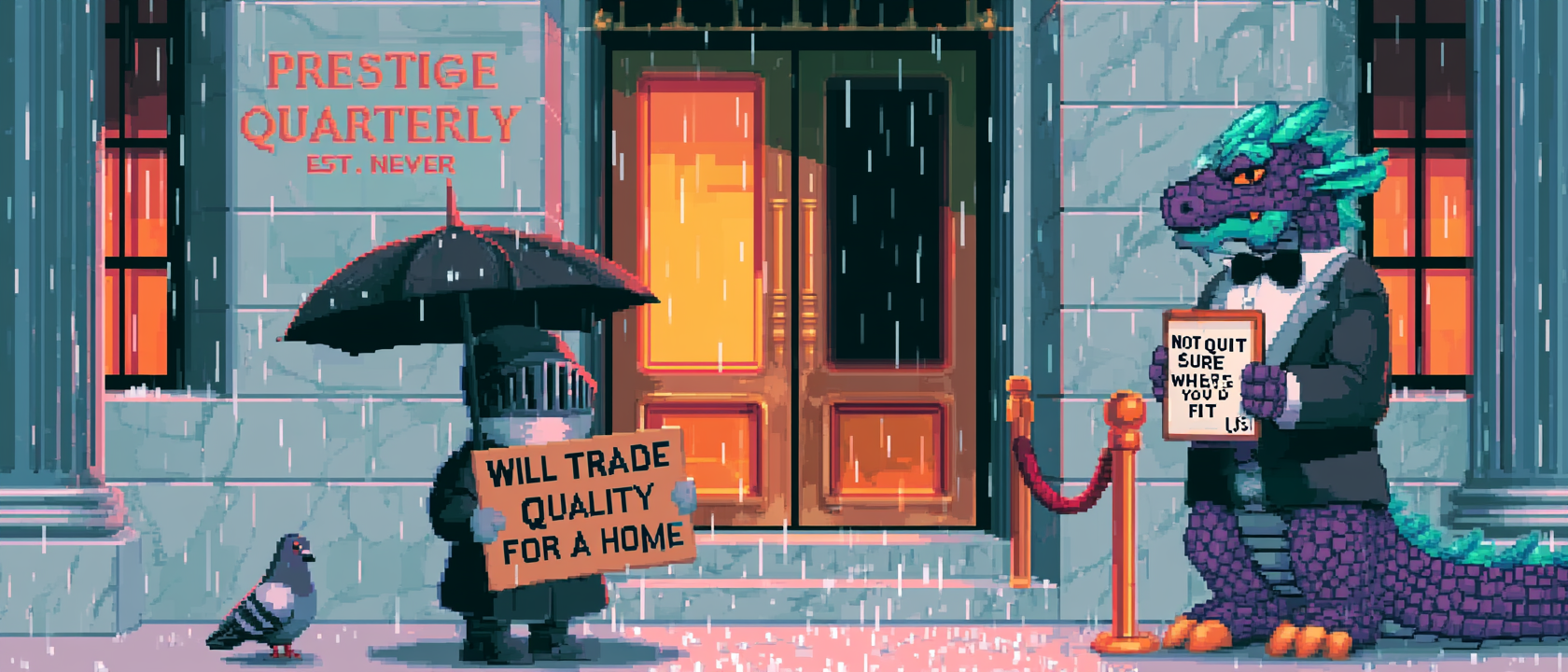
It has also never been published, and at this point I’ve made my peace with the strong possibility that it never will be. I’ve sent it to the fancy-pants fantasy journals more times than is dignified. Twice I got a personal reply — which, if you’ve ever submitted short fiction into the void, you know is basically a parade. And both times the reply boiled down to the same gentle little knife: “We liked it. We just don’t know where it would fit."
We liked it. We just don’t know where it would fit.
I’ve thought about that sentence more than I’d like to admit.
The actual story
Here’s the bones of it.
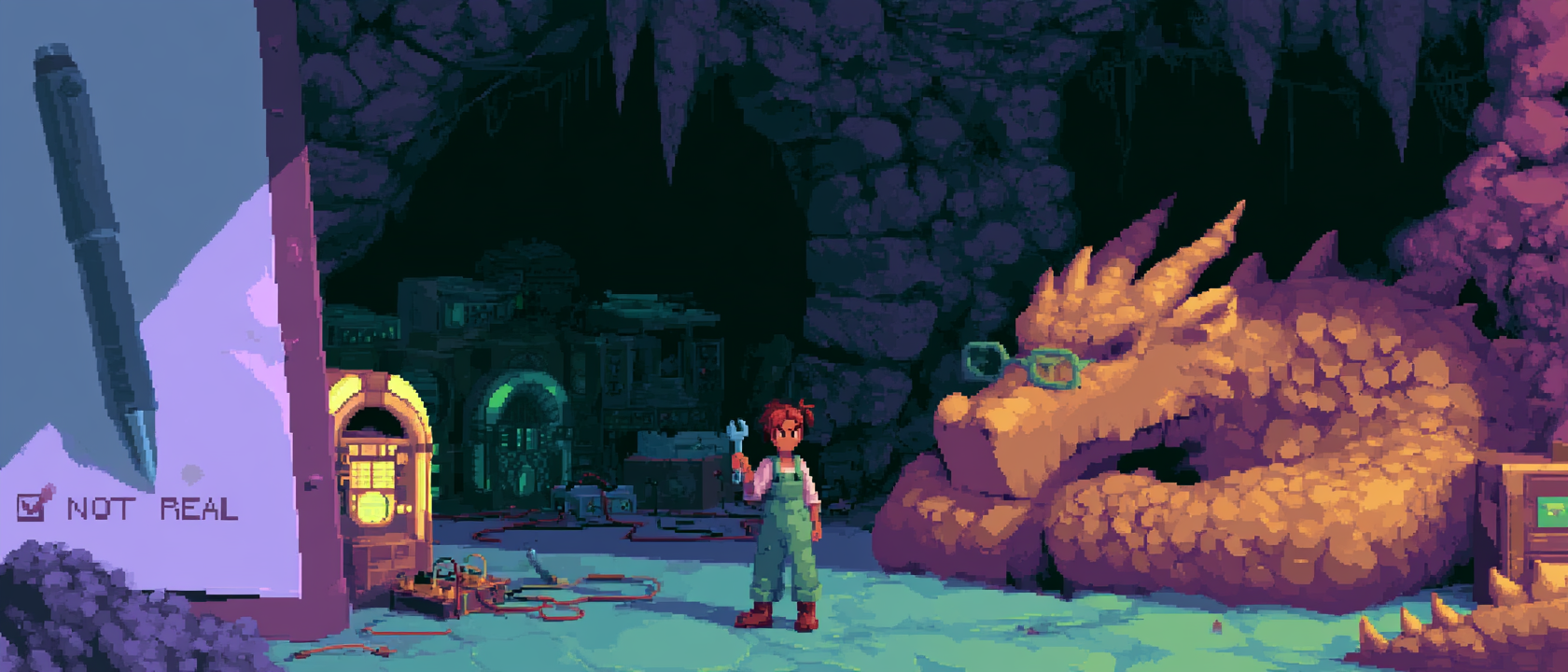
Benjamin is a dragon. He hoards electronics, because that’s what dragons do now — gold is for amateurs. To be a proper dragon, he decides he needs a damsel, so he kidnaps Alice Huang, a repair technician out of Denver. Alice is, reasonably, furious. Being kidnapped by a dragon will do that.
And then she looks around the cave.
It’s full of broken machines. Dead jukeboxes, gutted turntables, a graveyard of beautiful obsolete things, all of it just sitting there. And Alice — who fixes things for a living, whose whole brain is wired to look at a busted machine and see the version of it that still works — stops being a hostage and starts being an engineer. Weekdays she goes into the city and lives her normal life. Weekends she wires the jukeboxes and the turntables into Benjamin’s battery grid until the whole cavern hums.
They build something. It looks, if you squint, exactly like a life. A weird one. A good one.
Then Alice tells her therapist where she actually spends her weekends.
And the response isn’t huh, tell me more. It isn’t curiosity. It’s intervention. Medication she didn’t ask for. A diagnosis that takes every real, load-bearing, hand-built thing about her life and files it under symptom. The dragon becomes a delusion. The cave becomes a break with reality. The life she built with her own two hands becomes a thing that happened to her brain instead of a thing she did.
That’s the ending. That’s the whole engine.
Pretty awesome, right?
Why I think it doesn’t “fit”
For a long time I told myself it was a genre problem. It’s a fantasy story that isn’t really about the fantasy. It’s a dragon story where the dragon is the easy part. It’s got footnotes in it, eventually. It refuses to pick a lane, and lanes are how journals are organized.
All true. But I don’t think that’s the real reason.
I think it doesn’t fit because it’s quietly mean about the thing a lot of people would rather not look at: that “a life that works for you” and “a symptom” can be the exact same set of facts, and the only difference is who’s holding the clipboard.
That’s the part that snuck up on me. I didn’t sit down to write a thesis. I sat down to write a goofy story about a dragon who hoards toasters. But somewhere in the draft Alice stopped being a bit and started being someone I understood in my bones, and the ending wrote itself before I noticed what I was actually saying.
Because I know that flattening. Not the dragon part — I have not, to my knowledge, been kidnapped by a dragon, although I keep my schedule open. I mean the part where you build a way of living that works for you — the weird systems, the streaks-not-habits, the out-of-sight-out-of-mind workarounds, the thirty unfinished novels, the whole jury-rigged engine you wired together to keep the lights on inside your own head — and you describe it honestly to someone whose job is to help, and you watch their face change. You watch them stop hearing a life and start hearing a presentation. You said “this is how I work” and they heard “here is the disorder.”
That’s the move Dragon Hoard is about. Not “diagnosis bad” — diagnosis saved my actual life, I take the meds, I’m not romanticizing the cave. It’s narrower and meaner than that. It’s the specific moment where a true story gets received as a symptom, and the truth of it stops counting, because the person across the desk doesn’t live there and never will.
A life only looks like a malfunction from outside it.
So I doubled down, obviously
The healthy response to “nobody will publish my weird little story” would be to write something more publishable.
I, naturally, wrote twelve more in the same universe and built it into a whole bureaucratic dragon nightmare with an 80-page appendix of fictional government forms — but that’s a different post about a different flavor of insanity, and I’m not going to relitigate the forms here. (There are so many forms. I’m sorry. I’m not.)
This post is just about the one story. The first one. The one that started all of it and still hasn’t found a home and might never, and that I would still rather have written than anything else with my name on it.
Maybe it doesn’t fit anywhere because it’s about not fitting — about a life that’s real and functional and entirely yours, that the official channels can only see as a thing to be corrected. If a journal ever does find a slot for it, great, I’ll cry. If not, that’s a pretty on-theme ending for a story like this one, isn’t it. Rejected with a kind note that says we liked it, we just don’t know where it goes.
Yeah. Me neither. That’s sort of the point.
Stay weird, keep your weird systems, and don’t let anyone file your whole life under symptom.
— Dylan