
I have read a lot about writing, and I have read a lot about ADHD. What I haven’t read much of is the two of them together. I know there are authors with ADHD. I know ADHD representation in fiction has gone way up in recent years. But what I actually want is a deep dive into the difference between authors and ADHD authors — the mechanics of it, the wiring.
I have nothing to back this up with science. Just my experience. So, you know. Rigorous.
I have soooo many stories half-started, almost-finished, half-baked, and outlined. If you go look at dylanreed.com you’ll see something like thirty stories in various stages of existence. Is that too many? Not enough? Who knows! When I bring this up on writers' forums, the consensus seems to be that you should work on one thing at a time so you don’t get distracted. But there’s also a whole crowd who are planning one story, drafting a second, and editing a third all at once — and that seems to be pretty normal for “working” authors, too.
Back when I was more of a Pantser (someone who writes by the seat of their pants), I was hard-capped on how many stories I could juggle, purely by the storage space in my brain. Then I learned to outline. Now I can go absolutely feral with an outline, tuck it into the ideas folder, and let it sit there waiting to be written. Do I always follow the outline? No. Do the stories turn out the way I planned? Also no. But the outline lets me hop from story to story without losing the thread entirely. It’s great.
Here are a few just sitting in the ideas folder right now:
“The Library PI” — A reference librarian who moonlights as a finder-of-people for patrons too embarrassed to hire a real PI. The library system is her detective infrastructure: interlibrary loan, microfiche, the Sunday paper morgue. She gets paid in baked goods. Someone has started leaving anonymous hold requests for books that don’t exist in any catalog. Quiet, brainy, paper-smelling.
“The Cipher Knitter” — A retired GCHQ codebreaker who still consults from her cottage. Her village’s vicar brings her the parish puzzles (memorial brass rubbings, lost church-roll inscriptions); her cousin at MI5 sends her the difficult ones. The two streams collide when a coded message from the latter starts referencing locations from the former. Cozy on both sides; paranoia leaks in slowly through the same letterbox.
“The Building Super of the Last Walk-Up” — One of the last analog buildings in a fully smart-city district. The super maintains it manually: brass keys, paper rent ledgers, hand-stenciled mailboxes. The tenants are people who specifically want to live offline. When someone starts spoofing one tenant’s identity on the city grid, the super has to investigate the online world from his fully offline base. Fish-out-of-water cyberpunk cozy.
“The Apartment Super of Building Voornak” — A working-class apartment super in a brownstone full of Lovecraftian tenants. Mr. Sshhhhhk in 4B leaves slime on the stairs (she charges him for the extra mopping). Mrs. Voornak’s husband is a fog; she’s been “thinking about leaving him” for sixty years. The super loves her tenants. When a new mortal tenant turns up dead in the laundry room, she has to figure out which of her neighbors broke the building’s careful peace. Engine: cosmic horror played as HOA correspondence.
Full disclosure: I’ve actually started the outline for “The Apartment Super of Building Voornak.” It just seems fun, and I think Harper would like it. Which is a lot of how I pick what to write — they’re either stories I want to read (First of Mays, a cozy mystery at a circus), a style of book I love reading (Universal Basic Princess, fauxmance plus universal basic income), or stories for someone else (Closer on Paper, because Sarah loves You’ve Got Mail).
You may have noticed that I have drifted away from ADHD and writing.
Let me just push myself back on track.
OK.
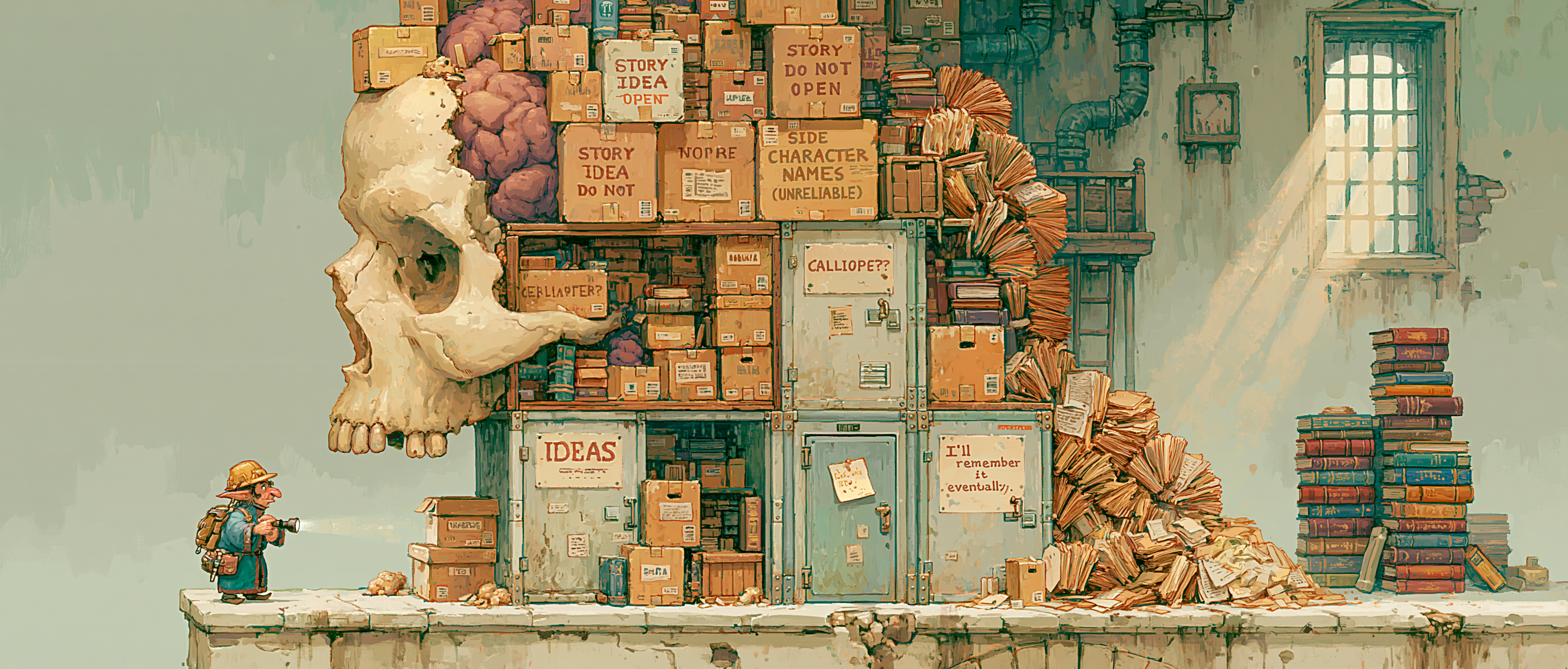
My personal flavor of ADHD brain is that I absorb all the info and keep it, but recalling it is a whole expedition. I’ll remember it eventually — I just have to dig. Instead of a memory palace, I have a memory hoarder. This means I can look at a story I wrote last week and have no idea what’s going on in it. If I haven’t read a story in yearslooking at you, Calliope and the Rogue Biologic it’s like reading it for the first time. Or, depending on what my brain is doing that particular day, I can open an early first draft and think, “ah yes, I know exactly what’s happening here.”
The upside is that every project stays weirdly fresh while I’m working on it. It’s almost like I’m writing serials[1] for myself. The downside is that I have a bad habit of changing a character’s name if I don’t check before I write — not usually a main character, but some load-bearing side character who is now named two different things in the same book.
Writing has also quietly become a way for me to work through “issues” that are apparently living deep in my subconscious. I’ve written two separate stories about doing a thing because it’s expected versus doing a thing because you enjoy it. I don’t even know anymore.
The biggest struggle for me and my ADHD, though, is that the second a story is done, I want it out in the world in the fastest way humanly possible. Which is why, many years ago, I published some things on Amazon that just… weren’t good. I’ve since taken them down and I’m rewriting them — but that’s a story for another post (a real one, coming soon, about the cursed math of indie publishing).
Anyway. Thirty stories. One brain. No notes.
Stay curious, outline like a maniac, and check your side characters' names before you hit publish.