
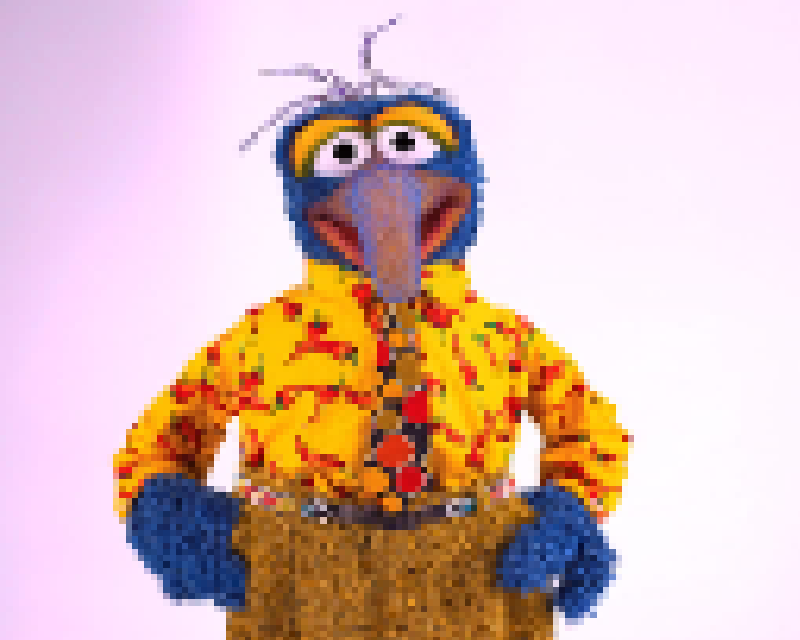
“I have a dream too! …I want to go to Bombay, India and become a movie star."
Nobody asked. Nobody understood. Nobody could explain why this made sense. Gonzo didn’t care. Gonzo had a dream.
Who Is Gonzo?
Gonzo is… actually, we don’t know what Gonzo is. That’s kind of the whole point.
He’s been called a “weirdo,” a “whatever,” and briefly, an alien from outer space (Muppets from Space, 1999, which the rest of the franchise quietly pretends didn’t definitively answer anything). He has a long blue nose, bug eyes, and the energy of someone who was told “no” so many times that he stopped hearing the word entirely.
He eats tires. He defuses bombs while reciting Shelley. He dates chickens. He launches himself from cannons as performance art. He’s been with the Muppets since the beginning, first as a vaguely unsettling creature in the background, then as a full-fledged agent of chaos.
Performed by Dave Goelz since 1976, Gonzo has evolved from a one-note weirdo into one of the most emotionally complex characters in the Muppet universe — which is saying something for a franchise where a frog and a pig have more relationship drama than most prestige television.
Why Gonzo Matters
Everyone asks “what are you?” at some point. We’re supposed to have answers. Labels. Categories. I’m this nationality, this profession, this identity, this type. The boxes feel safe. The boxes make sense.
Gonzo refuses boxes.
For years, the question of “what is Gonzo?” was a running gag. Nobody knew, including Gonzo himself. When asked about reincarnation, he replied: “How should I know? I don’t even know what I am this time.”
And here’s the thing — he didn’t seem bothered by it. He wasn’t in crisis. He wasn’t desperately seeking an answer. He was just… Gonzo. Eating tires. Dating Camilla. Living his best unclassifiable life.
There’s freedom in that. In letting go of the need to be definable. In accepting that maybe you’re not one thing, maybe you’re not any thing, and maybe that’s okay.
The Unhinged Analysis
Gonzo is the Muppet embodiment of existential freedom, and I will present this thesis to any philosophy department that will hear me out.
Sartre said existence precedes essence — that we are not born with a fixed nature but must create ourselves through our choices. Gonzo takes this further: he refuses to create a fixed self at all. Every day is a new opportunity to be whatever he feels like being.
He’s a performance artist. He’s a plumber. He’s a daredevil. He’s a romantic. He’s an alien. He’s not an alien. He’s whatever the moment requires.
Most of us are terrified by this kind of fluidity. We cling to our identities like life rafts. We need to know who we are so we can predict who we’ll be tomorrow.
Gonzo doesn’t need that prediction. He trusts that whoever he is tomorrow will be fine, because whoever he is today has been fine, and whoever he was yesterday was also fine. The through-line isn’t identity — it’s momentum.
He’s not “The Great Gonzo” because he’s accomplished great things. He’s great because he approaches everything — the cannons, the chickens, the tire-eating — with total commitment. With the sincere belief that whatever he’s doing right now matters, even if nobody else understands why.
“I have a dream too.” Not a sensible dream. Not an achievable dream. A dream that makes sense only to him. And that’s enough.
This is an installment of Muppet Monday Mornings, a weekly series where I write about felt creatures with more emotional depth than most prestige TV characters. Start your week with a Muppet.