
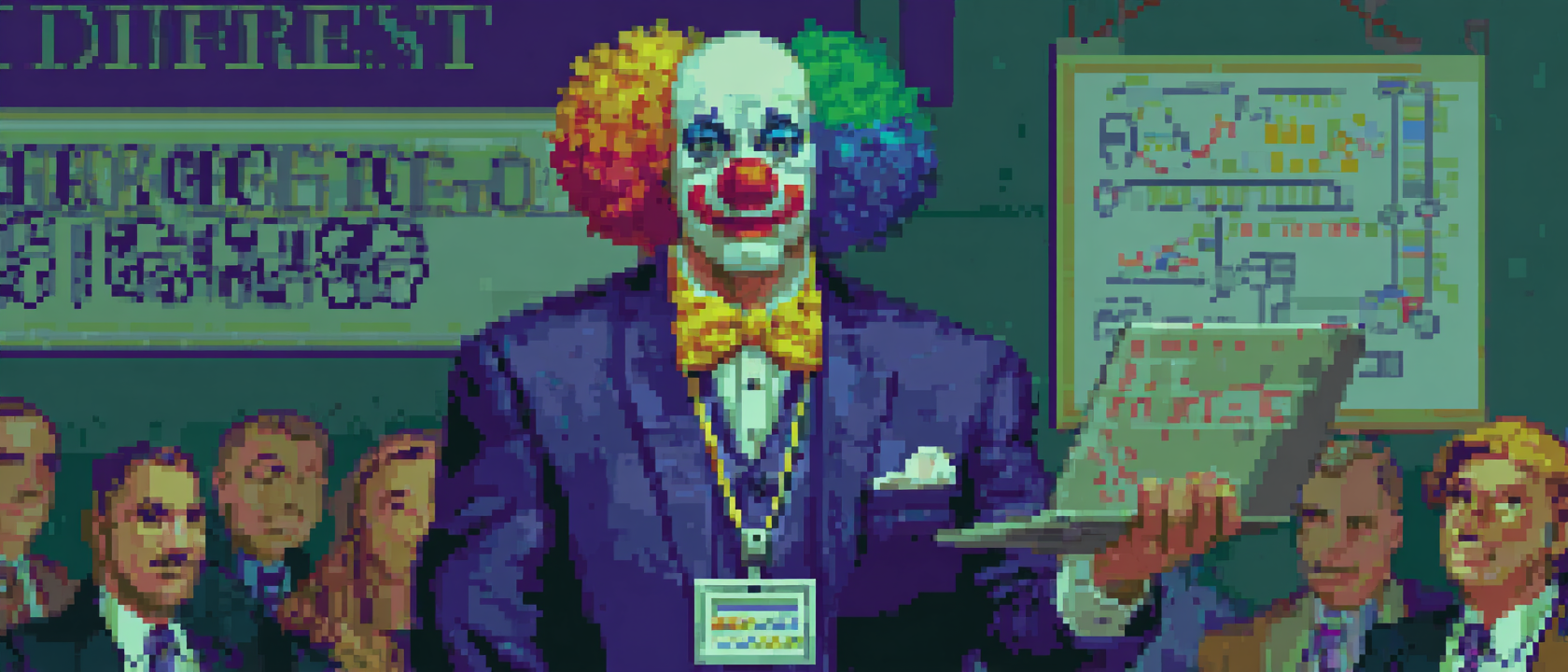
I’m pleased to announce that this year marks my 29th year as a professional clown.
I don’t say that to be funny. I say it because it’s true, and because the professional development I’ve accrued in those 29 years has directly and measurably contributed to my success in the technology sector. Next year will be 30. Three decades of demonstrated stakeholder engagement, real-time audience analytics, and high-pressure live deliverables. I want to talk about what that means.
But first, some context.
My Journey
I started clowning at 16. Not as a hobby. While my peers were studying data structures, I was learning how to read a room of forty kindergarteners and pivot my entire act in real time when one of them started crying because the balloon sword looked “too scary.” That is scope management. That is agile methodology in its purest form. I just didn’t have the vocabulary for it yet.
My brother Harper — and I need to be upfront about this — is genuinely brilliant at tech. Always has been. He’s the kind of person who looks at a system and just sees how it works, the way some people can hear a song once and play it back. I grew up adjacent to that world because of him. I understood it. I respected it. I didn’t want to be part of it.
Part of that was the shadow thing. When someone close to you is exceptional at something, there’s a gravitational pull to either compete in their space or find your own. I found my own. I found rooms full of people who needed to laugh, and I discovered I was very, very good at making that happen. I built a career around the radical premise that making people smile is valuable work.
Turns out it was also the best tech training I could have asked for.
Core Competencies
Let me break down the transferable skills, because I think the industry is sleeping on this pipeline.
Real-Time Stakeholder Engagement. When you’re performing for a live audience, there is no deploy rollback. There is no “we’ll patch it in the next sprint.” The stakeholder is right there, in front of you, and they are four years old, and they will tell you — loudly, in front of everyone — if your product is failing. I have received more honest, unfiltered user feedback in a single birthday party than most product managers get in a quarter. You learn to listen. You learn to adapt. You learn that the roadmap you walked in with is a suggestion, not a contract.
Cross-Functional Communication. This is the big one. The one that I think genuinely separates entertainers from the rest of the field. When you spend decades communicating complex ideas — timing, physical comedy, crowd dynamics — to audiences of every age, background, and attention span, you develop a muscle that a lot of technically brilliant people never build. You learn to meet people where they are.
I saw this with absolute clarity when I worked at Vayner3. My job involved explaining NFTs to marketing executives. If you’ve never had to explain a novel blockchain concept to a room full of people whose primary concern is Q3 campaign performance, let me assure you: it is not a technical challenge. It is a people challenge. The technology is the easy part. Getting a senior VP to understand why they should care, without making them feel stupid for not already knowing, while keeping the energy in the room from collapsing into glazed-over polite nodding — that is a performance. And I’d been training for it since I was 16.
Rapid Prototyping Under Pressure. A balloon animal is a prototype. I’m serious. You assess the client’s requirements in real time (“I want a giraffe!” “No wait, a DRAGON!"), you manage expectation versus capability (“I can make you a dragon that is also kind of a dog”), and you deliver a minimum viable product in under sixty seconds while maintaining stakeholder satisfaction. The feedback loop is immediate. The iteration cycle is measured in breaths. I have shipped more MVPs at children’s parties than most startups ship in a year.
Emotional Intelligence at Scale. You cannot be a working entertainer without developing an almost unreasonable sensitivity to how other people are feeling. Not what they’re saying — what they’re feeling. The room reads you’re doing constantly as a performer, adjusting your energy, your volume, your material based on dozens of nonverbal signals — that’s the same skill that makes the difference between a meeting that accomplishes something and a meeting that should have been an email. I just learned it by making balloon hats instead of reading a management book about it.
The Entertainer Advantage
My business partner Steve and I run nervous.net together. Steve is a world champion yo-yo performer. I am a clown approaching my 30th year of practice. Neither of us came up through traditional tech pipelines. Both of us pivoted into building software. And I genuinely believe our entertainer backgrounds are a competitive advantage, not a footnote.
Here’s why. Tech is full of people who can build things. It is not full of people who can explain what they built, why it matters, and why you should care — all while keeping you engaged and making you feel like a participant rather than a passenger. That’s a performance skill. That’s thousands of hours of reading rooms and adjusting on the fly and understanding that the person in front of you is not a user story. They are a person.
Steve and I pivot fast. Not because we read a book about pivoting. Because live performance teaches you that the plan is never the plan. The kid doesn’t want the giraffe anymore. The yo-yo string breaks mid-routine. The client changes the requirements ten minutes before the demo. You adapt. You keep the energy up. You deliver something that makes people feel good about what just happened, even if it wasn’t what anyone expected when they walked in.
The ROI of Making People Laugh
I love making people laugh. That’s not a mission statement — it’s a diagnosis. I love people. I love the moment when someone’s face shifts from neutral to delighted. I love that I get to do that for a living, and I love that the skills I built doing it have turned out to be exactly the skills that the tech industry claims to value but struggles to hire for.
Soft skills is a terrible name for them, by the way. There is nothing soft about reading a room of 200 people and adjusting your entire approach in real time. There is nothing soft about managing the emotional state of a client who is frustrated and scared and doesn’t understand what’s happening. Call them people skills. Call them communication skills. Call them “the reason your technically flawless product is failing because nobody on your team can explain it to a human being without using the word ‘leverage’ four times.”
I didn’t go to school for computer science. I went to school for making people feel things. And after 29 years of doing that — with one more to hit the big 3-0 — I can say with confidence that it prepared me for tech better than any degree could have.
The clown-to-tech pipeline is real. I am the evidence. And I am available for keynotes.