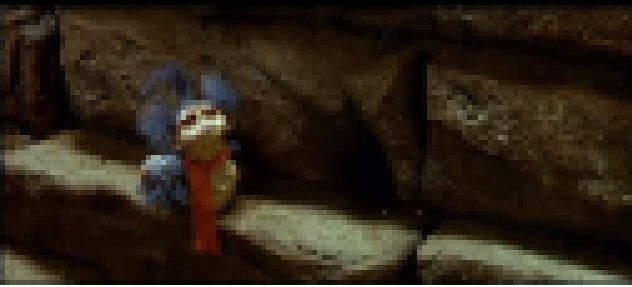
“If she’d have kept on going down that way, she’d have gone straight to the castle!"
He says this after Sarah walks away. She doesn’t hear him. The movie could have ended in ten minutes. The worm meant well.
Who Is The Worm?
The Worm is a tiny, friendly British creature who lives in the walls of the Labyrinth in the 1986 Jim Henson film of the same name. He appears for approximately two minutes of screen time. He changes everything.
When Sarah first encounters the maze, she thinks it’s a dead end — just two paths going left and right, walls everywhere. She’s frustrated. She’s lost. She’s about to give up.
Then a tiny voice says “‘Ello.”
“Did you say… hello?”
“No, I said ‘ello, but that’s close enough.”
The Worm reveals that the walls are full of openings she can’t see. Things aren’t what they seem. You can walk straight through what looks solid. He offers her tea. He invites her to meet the missus. He’s hospitable in a labyrinth designed to be hostile.
When Sarah thanks him and leaves, the Worm mutters that she shouldn’t have gone that way — the other direction would’ve taken her straight to the castle. She doesn’t hear. She wanders for another hour of movie.
Why The Worm Matters
The Worm gives Sarah the most important information she’ll receive in her entire journey: nothing in this place is what it seems. Walls aren’t walls. Dead ends aren’t dead ends. The rules you think apply don’t apply.
And then he accidentally sends her the wrong way.
That’s life, isn’t it? Someone offers you genuine help, real wisdom, actual kindness — and you still end up lost because the help wasn’t quite complete, or you didn’t hear the last part, or the helpful person didn’t realize what they didn’t know.
The Worm isn’t malicious. He’s delightful. He’d have given Sarah better directions if he’d known where she was going. But he didn’t ask, and she didn’t tell him, and so she goes the long way.
Every mentor, every guide, every kind stranger who’s ever helped you — they were the Worm. They gave you what they had. It wasn’t always what you needed. They did their best anyway.
The Unhinged Analysis
The Worm is the most important character in Labyrinth, and the movie treats him as a cameo.
Consider the narrative function: the Worm teaches Sarah that the Labyrinth operates on dream logic. That perception isn’t reality. That walls are illusions. Without this information, Sarah would be stuck forever. The Worm gives her the key to the entire puzzle.
And then — AND THEN — he accidentally sends her the wrong direction, extending her journey by hours and forcing her to grow as a person through the extended struggle.
The Worm is simultaneously the best thing that happens to Sarah and the reason the movie is feature-length. He’s salvation and complication in one tiny British package.
This is profound storytelling disguised as a throwaway gag. The Worm means well. The Worm does help. The Worm also ensures that Sarah can’t take a shortcut — that she has to earn her victory through the full journey.
“Come inside, and meet the missus!” he offers. She doesn’t. If she had, would she have learned more? Would the missus have mentioned the castle? Would Sarah’s entire path have changed?
We don’t know. We can’t know. We just know that somewhere in the Labyrinth, there’s a worm who tried to help, succeeded partially, failed partially, and has no idea he changed the entire course of a girl’s adventure.
That’s the Worm. That’s all of us, really.
This is an installment of Muppet Monday Mornings, a weekly series where I write about felt creatures with more emotional depth than most prestige TV characters. Start your week with a Muppet.